Web Security Exposed: Top Vulnerabilities Hackers Love (And How to Stop Them)
Learn the top web security vulnerabilities like SQL injection & XSS, how hackers exploit them, and simple fixes to protect your site. Includes real-world examples, free tools, and beginner-friendly tips.
Introduction
Imagine waking up to find your website defaced, customer data stolen, or your business locked out of its own system. Scary, right? The truth is, hackers don’t always break in—they slip in through tiny cracks left unsealed. Whether you’re a beginner or a pro, understanding web security flaws is like learning to lock your doors in a digital world.
In this guide, we’ll uncover the top web security vulnerabilities hackers exploit daily, how they’ve crippled big companies, and—most importantly—how you can stop them with simple, actionable steps. No jargon, just clarity. Let’s dive in.
Top Web Security Vulnerabilities and How to Prevent Them
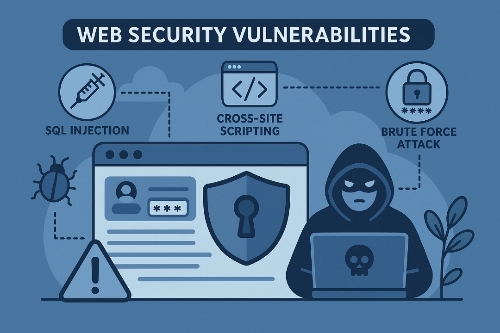
1. SQL Injection (SQLi)
What it is: Hackers inject malicious SQL code into input fields (like login forms) to trick your database into revealing sensitive data.
Real-world example: In 2019, a major airline leaked 9 million customer records due to SQLi.
Prevention:
– Use parameterized queries (e.g., with PDO or ORM tools).
– Escape user inputs.
– Tools: SQLMap (for testing), OWASP ZAP.
2. Cross-Site Scripting (XSS)
What it is: Attackers inject malicious scripts into your site, which run in users’ browsers (e.g., stealing cookies).
Real-world example: A popular forum was hacked via XSS, redirecting users to phishing sites.
Prevention:
– Sanitize user inputs (use libraries like DOMPurify).
– Implement Content Security Policy (CSP) headers.
– Tools: Burp Suite, XSS Hunter.
3. Cross-Site Request Forgery (CSRF)
What it is: Hackers trick users into executing unwanted actions (e.g., transferring money) while logged into a trusted site.
Real-world example: A bank’s CSRF flaw let attackers reset victims’ passwords.
Prevention:
– Use anti-CSRF tokens.
– Check Referer headers.
– Tools: CSRFTester, OWASP CSRFGuard.
4. Insecure Direct Object References (IDOR)
What it is: Attackers manipulate URLs or parameters to access unauthorized data (e.g., /user?id=123 → id=124).
Real-world example: A healthcare app exposed patient records via IDOR.
Prevention:
– Implement access controls (e.g., “Can this user view this data?”).
– Use indirect references (e.g., UUIDs instead of sequential IDs).
5. Security Misconfigurations
What it is: Default settings, unused features, or verbose error messages leak data.
Real-world example: A misconfigured AWS bucket exposed 50,000 government files.
Prevention:
– Regularly audit configurations.
– Disable debug modes in production.
– Tools: Nessus, Qualys.
Best Practices for Secure Coding
– Validate ALL user inputs.
– Use HTTPS everywhere (free via Let’s Encrypt).
– Keep software updated (patch management tools like Snyk).
– Limit user permissions (principle of least privilege).
Important Questions, Answers, and Explanations
1. Explain how each vulnerability can be exploited in a real-world scenario.
– SQLi: A hacker types ‘ OR ‘1’=’1 into a login form, bypassing authentication.
– XSS: A malicious script in a comment field steals session cookies from other users.
– CSRF: A user clicks a disguised link that silently transfers funds from their bank account.
2. Provide examples of tools that can help in identifying these vulnerabilities.
– SQLMap (SQLi), Burp Suite (XSS/CSRF), OWASP ZAP (general scanning).
3. Discuss the role of user education in preventing security breaches.
Teaching users to spot phishing emails, avoid weak passwords, and report suspicious activity reduces human-error breaches.
4. What are some common mistakes beginners make when addressing web security?
– Trusting user inputs blindly.
– Using outdated libraries.
– Ignoring error messages that leak system info.
5. How can small businesses implement these security measures effectively?
Start with free tools (OWASP ZAP), enforce strong passwords, and train staff on basic hygiene (e.g., not reusing passwords).
Important Phrases Explained
1. Zero-Day Vulnerability
A flaw hackers exploit before developers can patch it. Example: The 2021 Exchange Server hack.
2. Penetration Testing
Ethical hacking to find security gaps. Tools like Kali Linux automate tests.
3. Multi-Factor Authentication (MFA)
Requires a second proof (e.g., SMS code) to log in, blocking 99% of bot attacks.
4. Data Encryption
Scrambling data so only authorized parties can read it (e.g., AES-256 for databases).
5. Security Headers
HTTP headers like X-Frame-Options prevent clickjacking attacks.
Questions Also Asked by Other People Answered
1. “How often should I run security audits?”
At least quarterly, or after major updates. Automated tools like Nessus can run continuous scans.
2. “Is HTTPS enough to secure my website?”
No—HTTPS encrypts data in transit, but you still need input validation, firewalls, and secure coding.
3. “What’s the easiest way to prevent XSS?”
Use a library like DOMPurify to sanitize HTML inputs before rendering them.
4. “Can hackers bypass MFA?”
Rarely, but phishing (e.g., fake login pages) can steal MFA codes. Train users to verify URLs.
5. “How do I convince my team to prioritize security?”
Share real breach costs (e.g., $4M average for SMBs) and start with low-effort wins (e.g., enabling MFA).
Summary
Web security isn’t just for experts—it’s for anyone with a website. From SQL injection to misconfigurations, small oversights can lead to massive breaches. By validating inputs, using security tools, and educating users, you can build a robust defense. Start small, stay consistent, and turn your site into a fortress hackers avoid.
#WebSecurity #CyberSafety #HackingPrevention #SecureCoding #DataProtection #TechTips #OWASP #XSS #SQLInjection #SmallBusinessSecurity
Focus Key Phrase:
Top web security vulnerabilities and prevention
Slugs:
/top-web-security-vulnerabilities-guide
/beginner-web-security-tips
/how-to-prevent-sql-injection-xss
/web-security-best-practices
/small-business-cybersecurity-guide