How I Helped My Web Agency Get Found by Local Clients Using These 5 SEO Tactics
“Your perfect client is searching for you right now, but they’re finding your competitor” instead.
Practical local SEO strategies that helped a Lagos web agency attract nearby clients. Learn Google Business optimization, local keywords, citations, and mobile tactics you can use today.
Introduction
Here’s something that kept me up at night when I first started consulting with small web development agencies: they were building stunning websites for clients halfway across the world while people in their own neighborhood had no idea they existed.
I remember sitting with Tunde, who ran a three-person web development shop in Ikeja, Lagos. He showed me his portfolio, gorgeous stuff, modern designs, clean code, happy clients in London and Toronto. Then I asked him the question that changed everything: “How many clients do you have within a 10-mile radius?”
He stared at me. “Maybe two. People here don’t know we exist.”
That conversation happened three years ago. Today, his agency gets about 60 percent of its leads from local searches. People walking down the street, searching “web designer near me” on their phones, business owners in Victoria Island looking for someone they can meet face-to-face.
The shift didn’t happen because of some expensive marketing campaign or magic formula. It happened because we implemented basic local SEO strategies that most small agencies completely ignore.
If you run a web development agency, anywhere in the world, and you’re not showing up when someone in your city searches for your services, you’re leaving money on the table. Let me walk you through exactly what worked, what didn’t, and how you can do this yourself.
Why Local SEO Matters More Than You Think
When I talk to agency owners, they often tell me they want to work with clients in San Francisco, New York, London, the big markets with big budgets. I get it. I used to think the same way.
But here’s what I learned: local clients are different. They want to meet you. They trust you faster. They refer you to their friends. And most importantly, they’re searching right now.
Think about it. When someone in your city needs a website, they don’t want to coordinate Zoom calls across time zones. They want to grab coffee and show you their vision. They want to drive to your office when something needs fixing.
The competition for “web development services” globally is brutal. You’re fighting against agencies with massive budgets and established reputations. But “web development agency in Cedar Rapids” or “website design in Boise”? That’s a different game. That’s winnable.
Setting Up Your Google Business Profile the Right Way
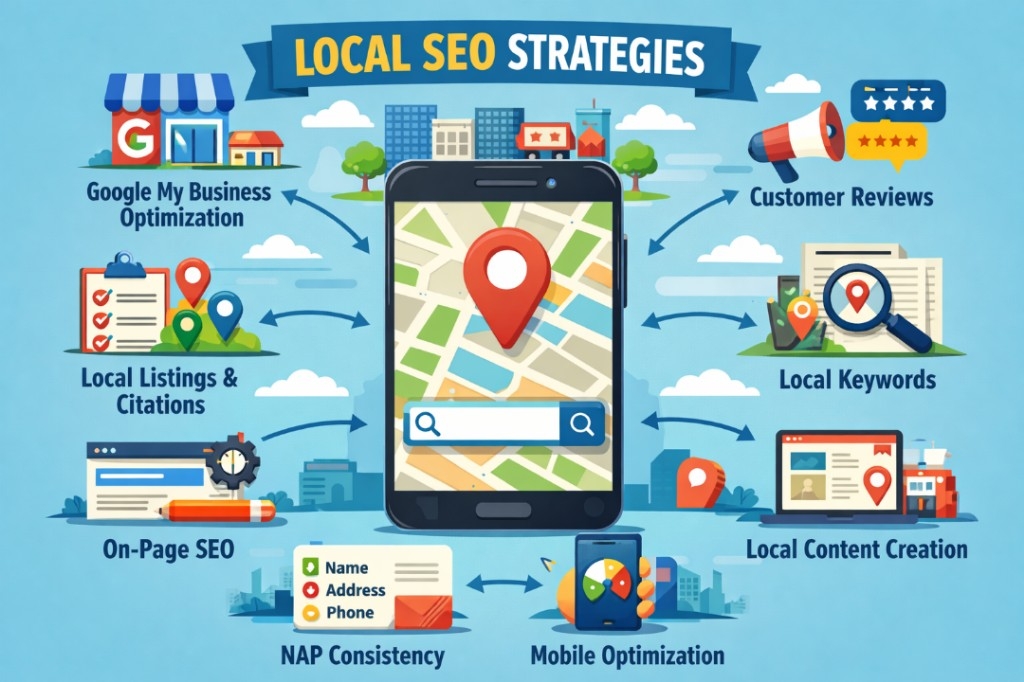
Let me start with the foundation, your Google Business Profile. I know this sounds basic, but most agencies either skip this entirely or set it up so poorly that it might as well not exist.
When Tunde and I started, his profile had his business name and a phone number. That’s it. No photos. No description. No category. Google had no idea what his business actually did.
Here’s what we did, and what you should do:
First, claim your profile if you haven’t already. Go to google.com/business and follow the verification process. Google will usually send a postcard to your address with a code. Yes, it takes a few days. Do it anyway.
Once you’re verified, fill out everything. And I mean everything. Business name, address, phone number, these need to be exactly the same everywhere they appear online. If your website says “123 Main Street” and your Google profile says “123 Main St,” you’re confusing Google. Pick one format and stick with it.
Choose your categories carefully. Your primary category should be the most specific option available. For a web agency, that might be “Website Designer” or “Web Development.” Then add secondary categories like “Marketing Agency” or “Graphic Designer” if they fit.
Upload photos. Not just your logo. Real photos. Your office space, your team working, screenshots of projects you’ve completed, even photos from local tech events you’ve attended. We uploaded about 30 photos for Tunde’s profile in the first month. Google loves fresh content, and so do potential clients.
The description is where you tell people what you do and where you serve. Don’t just say “We build websites.” Say “We’re a web development agency in Ikeja, Lagos, creating custom websites and digital solutions for local businesses across Victoria Island, Lekki, and surrounding areas.”
Post regular updates. I’m talking once or twice a week. Share a project you just finished. Announce you’re attending a local business event. Post a tip about website security. These updates show Google and potential clients that you’re active and engaged.
Reviews are the secret weapon. We created a simple system: every time Tunde finished a project, he’d send a thank-you email with a direct link to leave a Google review. Not pushy, just a polite request. Within six months, he had 23 reviews averaging 4.8 stars. That social proof is gold.
Finding and Using Local Keywords
Here’s where most agencies go wrong with local SEO. They optimize for “web development” or “custom websites,” huge, competitive terms that bring in traffic from people who aren’t in their service area.
Local keywords are different. They’re specific. They include your location.
I started by putting myself in the shoes of someone in Lagos who needed a website. What would they type into Google? “Web designer Lagos.” “Website development Ikeja.” “Affordable web design Victoria Island.” “Web agency near me.”
We used Google Search Console, which is free, to see what searches were already bringing people to Tunde’s site. Then we used Google’s autocomplete. Type “web design” into Google and see what it suggests. “Web design Lagos Nigeria.” “Web design companies in Lagos.” Gold.
Once you have your list, you need to use these keywords naturally throughout your site. I’m not talking about keyword stuffing. I’m talking about mentioning your location where it makes sense.
Your homepage title tag might be: “Custom Web Development Agency in Lagos, Nigeria.” Your meta description could say: “Award-winning web design and development services for businesses in Ikeja, Victoria Island, and across Lagos.”
We created separate location pages for different areas Tunde served. One page for Ikeja, one for Victoria Island, one for Lekki. Each page explained his services and included specific details about that area. We embedded a Google Map showing his location relative to that neighborhood. We mentioned local landmarks and spoke directly to businesses in those areas.
Don’t force it. If you’re writing a blog post about responsive design, you don’t need to shoehorn “Lagos” into every paragraph. But if you’re writing about web trends, you absolutely could write “Top Web Design Trends Lagos Businesses Should Watch in 2026.”
Making Your Site Work for Local Mobile Users
In Nigeria, like in most of the world now, people search on their phones. If your site doesn’t work perfectly on mobile, you’re done before you start.
I pulled up Tunde’s site on my phone during our first meeting. It took 11 seconds to load. The text was tiny. Half the images didn’t display properly. It was a disaster.
We rebuilt his site with mobile-first design. That means we designed for phones first, then adapted for desktop. Fast loading was the priority. We compressed every image. We minimized code. We used a lightweight theme.
The result? His site loaded in under three seconds on a 3G connection. That matters in markets like Nigeria where not everyone has blazing fast internet.
Responsive design isn’t optional. Your site needs to look good and work well whether someone’s on an iPhone, a Samsung Galaxy, or a budget Android phone.
We also added click-to-call buttons prominently on mobile. When someone searches “web designer near me” on their phone, they often want to call immediately. Make it easy.
Schema markup sounds technical, but it’s basically code that tells Google exactly what your business is and what you offer. We added LocalBusiness schema to Tunde’s homepage and Service schema to his service pages. It helps Google understand your site better and can get you enhanced listings in search results.
Internal linking helped too. Every service page linked to the relevant location pages and vice versa. This helps Google understand the structure of your site and keeps visitors clicking around.
Building Citations and Earning Reviews
Citations are mentions of your business name, address, and phone number on other websites. They help Google verify that your business is legitimate and where it’s located.
We started with the big directories. In the US, that would be Yelp, Yellow Pages, Better Business Bureau. In Nigeria, we used VConnect, Yellow Pages Nigeria, and other local directories. We made sure the NAP information was identical everywhere.
Consistency is everything. If you use “Street” on one site and “St” on another, fix it. If your phone number has a country code on one listing and not on another, standardize it.
Local backlinks are links from other websites in your area pointing to your site. These are powerful for local SEO. We reached out to Lagos tech hubs and co-working spaces where Tunde had worked and asked if they’d link to his site from their member directory. We wrote a guest post for a Nigerian tech blog. We got listed on a local chamber of commerce website.
You don’t need hundreds of these. A dozen quality local backlinks can make a real difference.
Reviews became a core part of Tunde’s process. Not just Google reviews, but also reviews on Facebook and industry-specific sites. We responded to every review, good or bad, professionally and personally. That engagement shows both Google and potential clients that you care.
Tracking What Works and Adjusting
You can’t improve what you don’t measure. We set up Google Analytics to track where traffic was coming from and what people did on the site. We paid special attention to traffic from Lagos and surrounding areas.
Google Search Console showed us which local keywords were bringing in impressions and clicks. Over time, we saw “web development Ikeja” climb from position 47 to position 3. That’s when the calls started coming in.
We tracked rankings manually too, just searching for our target keywords once a month and noting where Tunde’s site appeared. Not scientific, but it gave us a clear picture of progress.
The data told us what to double down on. Blog posts about local tech trends got shared more and brought in more local traffic. So we wrote more of them. Location pages for specific neighborhoods converted better than the generic services page. So we created more location pages.
We also ran some Google Ads targeted specifically at Lagos postcodes. This gave us quick wins while the SEO work was building momentum. The ads weren’t expensive, maybe fifty dollars a month, but they brought in qualified leads immediately.
The Ongoing Work
Here’s the truth about local SEO: it’s not a one-time project. It’s ongoing.
Tunde posts to his Google Business Profile every week. He publishes a blog post every two weeks, usually about something relevant to Lagos businesses or web trends. He asks for reviews after every project. He keeps building citations and earning local links.
But the effort pays off. Three years later, he’s turning away work because he’s too busy. His team has grown from three people to eight. And most importantly, he’s building relationships with business owners in his own city, people he can meet for lunch, people who become friends.
If you’re running a web development agency and you’re not doing local SEO, start today. Claim your Google Business Profile. Add your city to your title tags. Create a location page. Ask your last client for a review.
You don’t need to do everything at once. But you do need to start. Because right now, someone in your city is searching for exactly what you offer. And if they’re not finding you, they’re finding someone else.
Important Phrases Explained
Web Development Agency refers to a business or team that designs, builds, and maintains websites and web applications for clients. These agencies typically offer services ranging from simple website design to complex e-commerce platforms, custom web applications, and ongoing technical support. For small agencies, positioning themselves as local experts rather than competing globally can open up a steady stream of nearby clients who value face-to-face collaboration and quick response times.
Local SEO is the practice of optimizing your online presence to attract customers from specific geographic areas through search engines. Unlike traditional SEO that targets global or national audiences, local SEO focuses on appearing in results when people search for services “near me” or in specific cities and neighborhoods. It relies heavily on Google Business Profile optimization, local keywords, citations, and reviews to help businesses rank in the local pack, the map results that appear at the top of Google searches.
Google Business Profile, formerly known as Google My Business, is a free tool that lets businesses manage how they appear in Google Search and Maps. It displays your business name, location, hours, photos, reviews, and other key information directly in search results. For local businesses, a well-optimized Google Business Profile is often the single most important factor in local search visibility, influencing whether you appear in the coveted top three map results that users see first.
NAP Citations stand for Name, Address, and Phone number mentions of your business across the web. Search engines use these citations to verify your business location and legitimacy. Consistency in how your NAP appears across directories, your website, social media, and other platforms directly impacts your local search rankings. Even small discrepancies like using “Street” versus “St” can confuse search engines and weaken your local SEO efforts.
Schema Markup is structured data code added to your website that helps search engines understand your content better. For local businesses, LocalBusiness schema tells Google exactly what you do, where you’re located, your hours, and other relevant details. This can enhance how your site appears in search results, potentially earning you rich snippets with stars, business hours, or other eye-catching elements that improve click-through rates and visibility.
Questions Also Asked by Other People Answered
How long does it take to see results from local SEO efforts?
Most businesses start seeing initial improvements in local search visibility within four to eight weeks of implementing basic local SEO strategies like optimizing their Google Business Profile and building initial citations. However, significant results like consistent top-three rankings for competitive local keywords typically take three to six months of sustained effort. The timeline depends on your competition, how well you execute the strategies, and how established your online presence already is. Quick wins like Google Ads can bring immediate traffic while you build organic visibility.
Do I need a physical office address to rank in local search results?
While having a physical address that customers can visit strengthens your local SEO, it’s not absolutely required. Service area businesses like web development agencies that work at client locations can use their home address and set a service area in Google Business Profile without publicly displaying the address. However, you do need a real, verifiable address in the area you want to rank for. Post office boxes don’t work, and using a fake address violates Google’s guidelines and can get your profile suspended.
What’s the difference between organic local SEO and Google Ads for local businesses?
Organic local SEO focuses on earning visibility in unpaid search results through optimization, citations, reviews, and content. It takes time to build but provides sustainable, cost-free traffic once established. Google Ads delivers immediate visibility by paying for top placement in search results, letting you target specific locations and keywords right away. The best approach for most small agencies is using both: Google Ads for quick wins and immediate leads while building organic local SEO for long-term, sustainable growth.
How many Google reviews do I need to rank well locally?
There’s no magic number, but research shows businesses with more reviews than their competitors tend to rank higher in local pack results. More important than quantity is recency and consistency. Ten recent reviews in the past three months often outperform fifty reviews from two years ago. Aim to generate at least two to five new reviews per month while maintaining a high average rating. Quality matters too, detailed reviews that mention specific services or locations provide more SEO value than simple five-star ratings without text.
Can I do local SEO if I serve multiple cities or regions?
Absolutely. The strategy involves creating separate location pages for each city or region you serve, each optimized with local keywords and content specific to that area. You can’t claim multiple Google Business Profile listings for the same business unless you have actual physical locations in each area, but you can rank organically for multiple locations through well-optimized location pages, local content, and citations. Focus on your primary location first, then expand to secondary markets once you’ve established strong visibility in your main area.
Summary
Local SEO offers small web development agencies a powerful way to compete and win clients in their geographic area without the massive budgets required for national or global marketing. By claiming and optimizing your Google Business Profile with accurate information, photos, posts, and reviews, you create a foundation for local visibility. Integrating location-specific keywords naturally throughout your website, especially in dedicated location pages, helps search engines connect you with nearby searchers. Ensuring your site is mobile-friendly and fast-loading addresses the reality that most local searches happen on smartphones, particularly in markets with high mobile usage. Building consistent NAP citations across directories and earning local backlinks from community partners and local websites strengthens your legitimacy in Google’s eyes. The work is ongoing rather than one-time, requiring regular content creation, review generation, and performance tracking through tools like Google Analytics and Search Console. The payoff is a steady stream of qualified local leads from business owners who value proximity, want face-to-face relationships, and become sources of referrals within your community. Whether you’re in Lagos, Los Angeles, or London, these strategies work because they align your business with how people actually search for services in their area.
#LocalSEO
#WebDevelopment
#SmallBusiness
#DigitalMarketing
#SEOStrategy
local SEO, web development agency, Google Business Profile, local keywords, mobile optimization, small business marketing, SEO for agencies, local search ranking, Google reviews, citation building
Focus Key Phrase
local SEO for web development agencies
Suitable Slugs
local-seo-strategies-web-development-agencies/
local-seo-small-web-agencies-guide/
attract-local-clients-web-agency-seo/
google-business-profile-web-developers