
How Google’s Passage Indexing Really Works in 2026 — And Why Your Blog Needs It
“The Hidden Google Feature That’s Been Ranking Your Paragraphs Since 2021”
“Google might be ranking just one paragraph of your blog post, not the whole thing.”
Learn how Google’s Passage Indexing surfaces specific sections of your content in search results—and how to structure your posts to take advantage of it in 2026.
Introduction
I remember the first time I noticed something weird in my Google Search Console. One of my blog posts—a 4,000-word guide about database optimization—was suddenly getting traffic for a question I barely touched on. It was buried halfway through the article, just three paragraphs about indexing strategies. But Google was serving that section to people searching for that exact problem.
At first, I thought it was a fluke. Then I started seeing it happen again. And again. Different posts, different sections, same pattern. Google wasn’t just ranking my pages anymore. It was ranking pieces of them.
That’s when I realized what was happening: Passage Indexing.
If you’ve been writing blog posts for any length of time, you’ve probably experienced this too, even if you didn’t know what to call it. Google launched this feature back in 2021, and it’s still quietly working behind the scenes in 2026, changing how our content gets found. It doesn’t get the hype of algorithm updates or new AI features, but it’s actually one of the most practical shifts in search behavior for content creators like us.
Here’s the thing: you don’t need to create a separate page for every question your audience might ask. You don’t need to break your comprehensive guides into tiny, fragmented posts. Google can now pull out the relevant section from your long-form content and rank it independently for the right query.
But only if you structure it the right way.
In this post, I’m going to walk you through how Passage Indexing actually works, what’s changed in 2026, and how you can optimize your blog posts to take advantage of it. No jargon, no fluff. Just what you need to know to make your content more visible.
How Google’s Passage Indexing Really Works in 2026
Let’s start with what this thing actually is.
Passage Indexing sounds like Google is creating mini-indexes for every paragraph on your page. It’s not. Google still indexes your full page the same way it always has. But now, when someone searches for something specific, Google’s algorithms can evaluate individual passages within that page to see if they’re a better match for the query than the page as a whole.
Think of it like this: you wrote a 3,000-word post about home plumbing. It covers everything from pipe materials to water pressure to fixing leaks. Someone searches “how to fix a leaky faucet.” Your page might not rank well for that if the overall topic is too broad. But if you have a solid 150-word section that directly answers that question, Google can surface just that passage in the search results.
The passage doesn’t get its own URL. It’s still part of your main page. But Google highlights it, scrolls the user to it, and treats it as the relevant answer.
When Google first rolled this out in 2021, they said it would impact about 7 percent of search queries. That was mostly for niche, long-tail searches where people were asking very specific questions. Fast forward to 2026, and that number has likely grown, especially as search behavior has shifted toward conversational, question-based queries.
What makes this work under the hood is natural language processing. Google uses models like BERT and SMITH to understand the context and meaning of text, not just keywords. These models can break your content into semantic chunks—usually around 40 to 60 words—and evaluate whether each chunk is relevant to a user’s intent.
They’re also looking at entities, which are the people, places, things, and concepts mentioned in your content. If your passage mentions “faucet,” “washer,” “wrench,” and “leak,” Google understands those are related and that your passage is probably about fixing a faucet, not just mentioning it in passing.
In 2026, this has been further enhanced by Google’s focus on E-E-A-T: Experience, Expertise, Authoritativeness, and Trustworthiness. Passages aren’t just evaluated for keyword relevance anymore. Google’s looking at whether the passage seems credible, whether it’s written by someone who knows what they’re talking about, and whether it provides a complete, useful answer.
So if you’re writing about web development and you drop in a section about database schema design, Google’s going to look at whether that section is substantive, accurate, and backed by expertise. If it’s thin or generic, it probably won’t get pulled as a passage, even if it matches the query.
Why This Matters for Your Blog
Here’s why I care about this, and why you should too.
Most of us write long-form content. We want to cover topics thoroughly, give people everything they need in one place, and rank for a range of related searches. But traditionally, that meant your page was competing as a whole. If your topic was too broad, you’d lose out on specific queries. If it was too narrow, you’d miss traffic from related questions.
Passage Indexing changes that. It lets you have your cake and eat it too.
You can write a comprehensive guide that covers a topic in depth, and still rank for dozens of specific, long-tail queries buried within it. You don’t have to choose between thoroughness and specificity. You just have to structure your content so Google can find and understand those individual sections.
This is especially valuable for blogs in technical fields like web development, data management, and software engineering. Our readers are searching for precise answers: “How do I implement foreign keys in PostgreSQL?” or “What’s the difference between HTTP/2 and HTTP/3?” Those are the kinds of queries where passage indexing shines.
How to Structure Your Content for Passage Indexing
Alright, let’s get into the practical stuff.
The first thing you need to do is use clear heading hierarchies. I’m talking H1 for your main title, H2 for major sections, H3 for subsections, and H4 if you need to go deeper. Each heading should be descriptive and ideally include the keyword or question that section is answering.
For example, if you’re writing a guide about web hosting, don’t just use a heading like “Types of Hosting.” Use “What’s the Difference Between Shared and VPS Hosting?” That tells Google exactly what that section is about, and it matches the way people actually search.
Next, keep your paragraphs short. I’m talking two to three sentences, max. Each paragraph should start with a topic sentence that makes the main point clear. This isn’t just for readability—it helps Google identify the semantic boundaries of each passage.
If you’re explaining something step-by-step, use numbered lists. If you’re listing features or options, use bullet points. Google loves these formats for featured snippets, and they also help with passage identification because they’re visually distinct and easy to parse.
You don’t need to cram passages into every paragraph. Aim for three to six high-value passages per long-form post. These should be the sections that answer specific, searchable questions. Each one should be standalone—meaning someone could land on that section and get a complete answer without reading the rest of the page.
For example, in a post about JavaScript frameworks, you might have passages for “What is React used for?” “How does Vue compare to React?” and “When should you use Angular instead?” Each of those is a distinct question with a clear, concise answer.
Technical Optimizations That Actually Help
Here’s where a lot of bloggers drop the ball. You can have great content, but if your site’s technical foundation is weak, Google’s not going to surface your passages.
First, implement schema markup. Specifically, look at FAQPage schema if you have a Q&A format, HowTo schema if you’re writing tutorials, or Article schema for general blog posts. This structured data helps Google understand the context of your content and makes it easier to extract relevant passages.
You don’t need to be a developer to do this. There are plugins for WordPress like Yoast or Rank Math that can add schema automatically. If you’re on a custom platform, you can use Google’s Structured Data Markup Helper to generate the JSON-LD code and paste it into your page.
Second, make sure your site is fast and mobile-friendly. Google’s passage indexing is part of their broader mobile-first indexing approach, so if your site is slow or breaks on mobile, you’re shooting yourself in the foot. Use tools like PageSpeed Insights or GTmetrix to check your load times and fix any issues.
Third, use semantic HTML. That means proper use of header tags, paragraph tags, list tags, and so on. Don’t just style text to look like a heading with CSS. Use the actual H2 or H3 tag. This gives Google clear signals about the structure and hierarchy of your content.
Fourth, internal linking. Link to related sections within your own blog using descriptive anchor text. If you mention “database normalization” in one post, link to the section in another post where you explain it in detail. This helps Google understand the relationships between your passages and boosts the authority of those sections.
Finally, monitor your performance in Google Search Console. Go to the Performance report and filter by page or query. You can see which pages are getting impressions and clicks for specific long-tail queries, and that can tell you if your passages are being surfaced. If you’re not seeing passage-level traffic, it might be a sign that your structure or content needs work.
Keyword Strategy for Passages
This is where things get interesting.
Traditional SEO advice tells you to target one main keyword per page. But with passage indexing, you can target multiple related keywords, as long as each one has its own dedicated section.
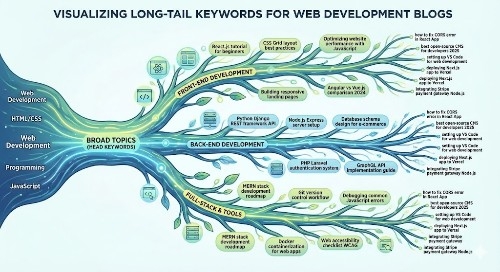
Start by doing keyword research with tools like AnswerThePublic, AlsoAsked, or even just Google’s “People also ask” box. Look for long-tail, question-based keywords that are related to your main topic but specific enough to warrant their own passage.
For example, if your main topic is “How to Build a REST API,” you might find related questions like “What’s the difference between REST and GraphQL?” “How do you handle authentication in REST APIs?” and “What are the best practices for API versioning?” Each of those becomes a section in your post, with its own H2 or H3 heading.
The key is to focus on user intent, not keyword density. Don’t stuff keywords into your passages. Write naturally, answer the question thoroughly, and use the language your audience actually uses. Google’s NLP models are smart enough to understand synonyms and context, so you don’t need to repeat the exact phrase over and over.
Also, prioritize quality over quantity. It’s better to have five killer passages that genuinely answer user questions than twenty mediocre ones that barely scratch the surface. Google’s E-E-A-T emphasis means they’re looking for depth, accuracy, and expertise.
What’s Changed in 2026
So what’s different now compared to when Passage Indexing first launched?
Honestly, the core mechanics are the same. Google hasn’t announced any major overhauls. But the integration with AI-driven search has made it more sophisticated.
Google’s algorithms are better at understanding context and nuance. They can identify passages that demonstrate expertise based on the depth of explanation, the use of technical terminology, and the presence of supporting evidence like examples or data.
They’re also better at detecting thin or duplicated content. If your passage is just a rephrased version of something that’s already ranking, it’s not going to get much love. You need to bring something new to the table—whether that’s a unique perspective, a detailed explanation, or a practical example.
Another shift is the emphasis on author credibility. If you have an author bio that establishes your expertise, if you cite reputable sources, if you include personal experience or case studies, those are all signals that boost the perceived E-E-A-T of your passages.
And finally, user engagement metrics matter more. If people land on your passage and immediately bounce, or if they scroll past it without engaging, that’s a signal to Google that the passage wasn’t helpful. On the flip side, if people read it, click through to other sections, or spend time on the page, that boosts its ranking potential.
Important Phrases Explained
Passage Indexing refers to Google’s ability to rank and display specific sections of a webpage independently in search results, rather than evaluating only the page as a whole. Introduced in 2021, this feature allows long-form content to compete for multiple niche queries by surfacing the most relevant paragraphs or passages. It’s not a separate index—Google still indexes full pages—but the algorithm evaluates semantic chunks of text to match user intent more precisely.
Semantic Search is the practice of understanding the meaning and context behind search queries and content, rather than just matching exact keywords. Google uses natural language processing models like BERT and MUM to interpret entities, relationships, and intent, which powers features like Passage Indexing. For bloggers, this means writing naturally and focusing on answering user questions clearly, rather than stuffing content with keywords.
E-E-A-T stands for Experience, Expertise, Authoritativeness, and Trustworthiness. It’s a set of quality signals Google uses to evaluate content, especially for topics that could impact a person’s health, finances, or well-being. In the context of Passage Indexing, passages that demonstrate strong E-E-A-T—through author credentials, cited sources, detailed explanations, and practical examples—are more likely to rank well.
Schema Markup is structured data code added to a webpage to help search engines understand the content’s context and purpose. Common types include FAQPage, HowTo, and Article schema. Implementing schema can improve how Google interprets passages, increases the chance of appearing in rich snippets or featured results, and provides clearer signals about the entities and topics covered in each section.
Long-Tail Keywords are specific, multi-word search phrases that typically have lower search volume but higher intent and conversion potential. Examples include “how to fix a leaky faucet in a bathroom” or “best practices for API authentication in Node.js.” Passage Indexing is particularly effective for these queries because it allows detailed sections within comprehensive guides to rank for very specific questions.
Questions Also Asked by Other People Answered:
Does Passage Indexing mean I should break up my long posts into shorter ones? No, not at all. The beauty of Passage Indexing is that it rewards comprehensive, long-form content by allowing individual sections to rank independently. You don’t need to fragment your posts into separate pages. Instead, focus on structuring your long-form content with clear headings, concise passages, and standalone answers to specific questions. This way, you get the SEO benefits of both depth and specificity.
How do I know if my passages are being indexed and ranked? You can check Google Search Console under the Performance report. Look at the queries driving traffic to your pages and see if they’re highly specific, long-tail questions that correspond to individual sections of your content. If you’re getting impressions and clicks for these niche queries, it’s a good sign that Google is surfacing your passages. You can also manually search for specific questions your content answers and see if your passage appears.
Will Passage Indexing hurt my rankings for the main topic of my page? Generally, no. Passage Indexing is designed to complement, not replace, traditional page-level ranking. Your page can still rank for broader keywords while also ranking for specific queries through individual passages. The key is to maintain a clear, cohesive structure and ensure your page has a strong topical focus. If your content is scattered or unfocused, that could hurt overall rankings, but that’s a content quality issue, not a problem with Passage Indexing itself.
Do I need to use special tags or code to enable Passage Indexing? No special tags are required. Passage Indexing works automatically on all indexed pages. However, using semantic HTML (proper heading tags, paragraph tags, lists) and implementing schema markup can help Google better understand and extract your passages. Think of it as making your content easier for Google to parse, rather than enabling a feature that’s already active.
Can I optimize for Passage Indexing on older blog posts? Absolutely. In fact, updating older posts is one of the best ways to take advantage of this feature. Go back to your high-traffic posts, add clear H2 and H3 headings for key sections, tighten up your paragraphs, incorporate lists where appropriate, and add schema markup if you haven’t already. This can breathe new life into existing content and help it rank for additional long-tail queries you might have missed initially.
Summary:
Google’s Passage Indexing is a quiet but powerful shift in how search results work. Instead of ranking only full pages, Google can now surface specific sections of your content for relevant queries. This means your long-form blog posts can compete for dozens of niche, question-based searches without sacrificing depth or comprehensiveness.
The key to taking advantage of this is structure. Use clear, descriptive headings. Write concise paragraphs that start with topic sentences. Incorporate lists and bullets where they make sense. Aim for three to six high-value passages per long post, each answering a specific question.
On the technical side, implement schema markup, ensure your site is fast and mobile-friendly, use semantic HTML, and monitor your performance in Google Search Console. Focus on long-tail keywords and user intent, and demonstrate expertise through detailed explanations, examples, and credible sources.
In 2026, Passage Indexing is more integrated with AI-driven search and E-E-A-T evaluation, which means quality and credibility matter more than ever. But the fundamentals remain the same: write comprehensive, well-structured content that genuinely answers the questions your audience is asking. If you do that, Google will do the rest.
#PassageIndexing
#SEOStrategy
#ContentOptimization
#WebDevelopment
#GoogleSearch
# Tags
Passage Indexing, SEO optimization, Google search, content structure, E-E-A-T
# Focus Key Phrase
Google Passage Indexing
# Suitable Slugs
google-passage-indexing-2026
how-passage-indexing-works
optimize-blog-passage-indexing
passage-indexing-seo-guide