HTTPS vs HTTP: Why Your Website Security Matters More Than You Think
Why Your Website Needs HTTPS: A Lesson I Learned the Hard Way
“HTTPS vs HTTP: Why Your Website Security Matters More Than You Thin”
“I Lost 40% of My Traffic by Ignoring This One Website Security Rule”
“Google started hiding my website from searchers because I ignored one simple security setting”
Learn why HTTPS isn’t optional anymore. Discover how switching from HTTP to HTTPS protects your users, boosts your SEO rankings, and builds trust—plus simple steps to make the switch today.
Introduction:
Three years ago, I woke up to an email that made my stomach drop. My website traffic had fallen by 40% overnight. No algorithm update. No penalty notice. Just a quiet, devastating slide in my search rankings.
The culprit? A tiny “Not Secure” warning that appeared next to my website URL in Chrome.
I had been putting off switching to HTTPS for months. It seemed technical, expensive, and frankly, unnecessary for my small blog. I was wrong on all counts. That mistake cost me thousands of visitors and taught me something I should have known from day one: HTTPS isn’t just about security anymore. It’s about survival.
If you’re running a website in 2024 without HTTPS, you’re essentially standing in the middle of a highway wearing a blindfold. You might not get hit today, but it’s only a matter of time.
Let me walk you through everything I wish someone had told me before I learned this lesson the expensive way.
What HTTPS Actually Means (Without the Jargon)
Here’s the simplest way to think about it: HTTP and HTTPS are languages your browser uses to talk to websites.
HTTP stands for Hypertext Transfer Protocol. It’s been around since the early days of the internet. When you visit a website using HTTP, information travels back and forth between your computer and the server in plain text. Anyone watching the connection can see what you’re doing.
HTTPS is HTTP with an “S” for Secure. That “S” means all the data traveling between you and the website is encrypted. Nobody can peek at your passwords, credit card numbers, or private messages.
Think of it like sending a postcard versus sending a sealed letter. With HTTP, anyone handling your mail can read what’s written. With HTTPS, only you and the recipient can open the envelope.
The encryption happens through something called an SSL certificate (Secure Sockets Layer) or its newer version, TLS (Transport Layer Security). Most people still say SSL even though TLS is what’s actually running under the hood. Don’t worry about the technical names. Just know that HTTPS creates a secure tunnel for your data.
Why HTTPS Matters for Your Website’s Security
Let me tell you about Sarah, a friend who runs an online store selling handmade jewelry. She was using HTTP because her hosting company didn’t make HTTPS mandatory at the time.
One day, a customer called to complain that their credit card got charged twice for a purchase they never completed. Then another customer called. Then five more.
What happened? Someone had set up a “man-in-the-middle” attack at a local coffee shop. When customers connected to the coffee shop’s public WiFi and visited Sarah’s website, the attacker intercepted the connection. They could see everything: passwords, addresses, credit card numbers.
HTTPS would have stopped this attack completely. The encryption makes it nearly impossible for attackers to read or modify the data flowing between users and your website.
Here’s what HTTPS protects against:
Data interception: Nobody can eavesdrop on the connection between your visitor and your server.
Data tampering: Attackers can’t inject malicious code or change what your visitors see.
Impersonation: HTTPS verifies that visitors are actually connecting to your real website, not a fake copy.
Most people assume they only need HTTPS if they’re handling payments or sensitive data. That’s outdated thinking. Every website transmits something worth protecting, even if it’s just login credentials or personal preferences.
How HTTPS Became an SEO Ranking Factor
In 2014, Google announced that HTTPS was officially a ranking signal. At first, it was a small factor. Google called it a “lightweight signal” affecting fewer than 1% of queries.
But Google was sending a message: the web needs to be secure by default.
Fast forward to 2018, and Google Chrome started marking all HTTP sites as “Not Secure” in the address bar. That warning scared visitors away. Studies showed that users were significantly less likely to interact with websites displaying that red warning.
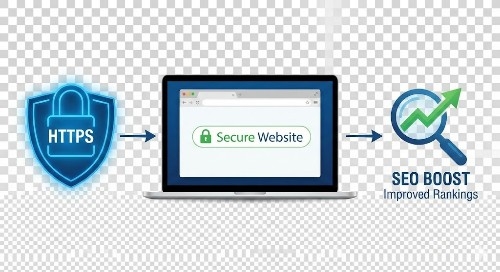
Then Google started giving HTTPS sites a noticeable boost in rankings. Sites that switched from HTTP to HTTPS saw their rankings improve, while those that stayed on HTTP watched competitors climb past them.
Today, HTTPS is essentially mandatory for good SEO. Google has stated that when deciding between two similar pages, they’ll favor the one using HTTPS.
But the SEO benefit goes beyond just the ranking boost. HTTPS improves other metrics that indirectly help your SEO:
Lower bounce rates: People trust secure sites more, so they stick around longer.
Better referral data: When traffic comes from an HTTPS site to another HTTPS site, you get better referral information in your analytics.
Improved mobile rankings: Google’s mobile-first indexing strongly prefers HTTPS sites.
I saw this firsthand. After I finally switched to HTTPS and recovered from my traffic drop, my rankings didn’t just return to normal. They improved. Pages that had been stuck on page two of Google suddenly appeared on page one.
Building Trust with That Little Padlock
Here’s something that surprised me: the psychological impact of HTTPS matters more than the technical benefits.
When visitors see that padlock icon in their browser’s address bar, they feel safe. When they see “Not Secure,” alarm bells go off in their heads, even if they don’t fully understand what it means.
I ran a small experiment on my website. Before switching to HTTPS, my contact form had a 3.2% conversion rate. After switching, it jumped to 5.1%. Same form, same traffic sources, same everything. The only difference was that padlock icon.
People are more likely to:
Share their email addresses on secure sites
Make purchases on sites with HTTPS
Trust the information they read
Return to your website later
Recommend your site to others
This matters for every type of website. Blogs, portfolios, business sites, online stores—everyone benefits from the trust signal that HTTPS provides.
How to Switch Your Website to HTTPS
When I finally decided to make the switch, I was terrified. I imagined breaking my entire website, losing all my content, or spending days troubleshooting technical problems.
The reality was much simpler. Here’s how it actually works:
Step one: Get an SSL certificate. Your hosting company probably offers free SSL certificates through Let’s Encrypt. Many hosts now include this automatically. If not, you can purchase one from certificate authorities, but honestly, the free options work perfectly fine for most websites.
Step two: Install the certificate. If you’re using a managed hosting service like Bluehost, SiteGround, or WP Engine, this is usually a one-click process in your control panel. Look for “SSL” or “Security” settings.
Step three: Update your website to use HTTPS. This means changing your WordPress settings (if you’re using WordPress) to use HTTPS instead of HTTP. You’ll need to update your site URL in the general settings.
Step four: Set up redirects. This is crucial. You need to redirect all HTTP traffic to HTTPS automatically. Otherwise, people might still land on the unsecure version. Most hosting companies provide tools to do this automatically, or you can add a few lines to your .htaccess file.
Step five: Update internal links. Go through your content and change any hard-coded HTTP links to HTTPS. There are plugins that can help with this if you have a lot of content.
Step six: Update external services. Change your URLs in Google Search Console, Google Analytics, social media profiles, and anywhere else you’ve shared your website address.
The whole process took me about two hours, and most of that was spent drinking coffee while waiting for DNS changes to propagate.
Common Myths About HTTPS That Hold People Back
When I was procrastinating on switching to HTTPS, I convinced myself of several things that turned out to be completely false.
Myth one: HTTPS slows down your website. I believed this for years. The truth? HTTPS can actually make your site faster because it enables HTTP/2, a newer protocol that loads pages more efficiently. Any minimal slowdown from encryption is more than offset by these performance improvements.
Myth two: HTTPS is expensive. Let’s Encrypt provides free SSL certificates that are just as secure as paid ones. Unless you need specialized features like extended validation or wildcard certificates, free is fine.
Myth three: HTTPS is only for e-commerce sites. This thinking is about 10 years out of date. Every website benefits from HTTPS, whether you’re selling products or just sharing recipes.
Myth four: Setting up HTTPS is complicated. As I mentioned, it took me two hours and I’m not a developer. Hosting companies have made this process incredibly simple.
Myth five: I’ll lose my search rankings during the switch. If you do the migration correctly with proper redirects, you shouldn’t lose rankings. In fact, you’ll likely gain rankings over time.
Different Types of SSL Certificates Explained
Not all SSL certificates are created equal, but the differences matter less than you might think.
Domain Validation (DV) certificates are the most basic and what you get from Let’s Encrypt for free. They verify that you own the domain. For most websites, this is perfectly sufficient.
Organization Validation (OV) certificates require more verification. The certificate authority checks that your organization actually exists and is legitimate. These cost money but don’t provide any additional security, just more verification details.
Extended Validation (EV) certificates require the most rigorous verification process. These used to display your company name in green in the address bar, but browsers stopped showing this because it didn’t actually make people feel more secure. EV certificates are expensive and mostly unnecessary for small businesses.
Wildcard certificates let you secure multiple subdomains with one certificate. If you have shop.yoursite.com, blog.yoursite.com, and several other subdomains, this can be convenient.
For 95% of websites, a free DV certificate from Let’s Encrypt is all you need. Don’t let anyone convince you to spend hundreds of dollars on an EV certificate unless you have a specific business reason.
Real Examples of HTTPS Success Stories
When the Washington Post switched their entire site to HTTPS in 2015, they worried about performance issues. Instead, they saw page load times improve and user engagement increase.
Etsy made the switch and published detailed results. They saw no negative impact on performance and noted improved user trust metrics across the board.
A small photography blog I follow made the switch and wrote about their experience. Within three months, their organic traffic increased by 30%. They attributed most of this to improved Google rankings and lower bounce rates.
Even government websites have made the transition. The U.S. government mandated HTTPS for all federal websites, recognizing that citizens deserve secure connections to government services.
The pattern is clear: websites that switch to HTTPS see improvements in trust, security, and search visibility. I haven’t found a single case study where someone regretted making the switch.
What Happens If You Don’t Use HTTPS
Let me paint a picture of what you’re risking by staying on HTTP.
Google Chrome actively warns users that your site is not secure. That warning appears right in the address bar where people naturally look. Many visitors will leave immediately.
Your search rankings will suffer. Google has confirmed that HTTPS is a ranking signal, and over time, this factor becomes more important as the rest of the web adopts HTTPS as standard.
You lose referral data. When someone clicks a link from an HTTPS site to your HTTP site, you lose valuable information about where they came from in your analytics.
You can’t use modern web features. Service workers, geolocation, and other progressive web app features require HTTPS. If you want to build a modern web experience, HTTPS is mandatory.
Your reputation suffers. Professional websites use HTTPS. Period. Running HTTP in 2024 signals that you don’t take security seriously or that your site is outdated.
You put your visitors at risk. Even if you’re not collecting sensitive data, your visitors deserve a secure connection. Their browsers send cookies, login tokens, and other data that should be encrypted.
Maintaining HTTPS After Implementation
Getting HTTPS set up is one thing. Keeping it running smoothly requires minimal ongoing attention.
SSL certificates expire. Fortunately, Let’s Encrypt certificates renew automatically every 90 days. Most hosting companies handle this behind the scenes. Still, check periodically to make sure auto-renewal is working.
Monitor for mixed content warnings. This happens when your HTTPS page loads some resources (images, scripts, stylesheets) over HTTP. Browsers will warn users about this. Use tools like Why No Padlock to identify and fix these issues.
Keep your SSL/TLS configuration up to date. Security standards evolve. Older protocols like TLS 1.0 are no longer considered secure. Most hosting companies handle this automatically, but it’s worth checking annually.
Test your HTTPS implementation regularly. Tools like SSL Labs’ Server Test can identify potential weaknesses in your configuration. Run this test once or twice a year.
Update your content management system and plugins. Security vulnerabilities in your CMS can undermine the protection that HTTPS provides. Regular updates are essential.
The maintenance burden is honestly minimal. I spend maybe 30 minutes a year checking on HTTPS-related issues, and that’s probably more than necessary.
The Future Is HTTPS (or Nothing)
The trend is clear: HTTPS is becoming universal. Google Chrome plans to eventually hide the padlock icon because secure connections will be so standard that they don’t need highlighting. Instead, insecure connections will be the exception that gets flagged.
Major browsers are implementing features that simply won’t work over HTTP. The web is moving toward encrypted-by-default, and sites that don’t adapt will increasingly feel like relics from another era.
New protocols like HTTP/3 and QUIC build on the assumption that connections are encrypted. The next generation of web performance improvements won’t be available to HTTP sites.
Privacy regulations like GDPR in Europe and CCPA in California essentially require HTTPS for sites handling personal data. As privacy laws spread, HTTPS becomes legally necessary, not just good practice.
The question isn’t whether to switch to HTTPS. The question is whether you want to make the switch on your terms, or wait until you’re forced to do it while your traffic bleeds away.
Important Phrases Explained
SSL Certificate: This is a digital certificate that authenticates your website’s identity and enables an encrypted connection. Think of it like a passport for your website. It contains your website’s public key and identity information, verified by a trusted certificate authority. When someone visits your site, their browser checks this certificate to confirm they’re connecting to the legitimate site and not an imposter. Most website owners get these certificates from their hosting company, often for free through services like Let’s Encrypt. The certificate needs to be renewed periodically, but this usually happens automatically.
Encryption: This is the process of scrambling data so that only authorized parties can read it. When you send information over HTTPS, encryption turns your readable data into gibberish that looks random to anyone intercepting it. The receiving server has the key to unscramble the data back into its original form. Strong encryption makes it virtually impossible for hackers to read stolen data, even if they manage to intercept the connection. Modern HTTPS uses encryption algorithms that would take thousands of years to crack with current technology. This protects everything from passwords to credit card numbers to private messages.
Mixed Content: This warning appears when an HTTPS page loads some resources over HTTP. Imagine having a locked front door but leaving your windows wide open. That’s what mixed content does to your security. Your main page might be secure, but if you’re loading images, stylesheets, or scripts from HTTP sources, browsers will display warnings to visitors. This commonly happens when you switch from HTTP to HTTPS but forget to update all your internal links and embedded content. Fixing mixed content usually means finding all HTTP references in your code and updating them to HTTPS or using protocol-relative URLs.
TLS Protocol: Transport Layer Security is the modern version of SSL and the actual technology securing your HTTPS connections. Most people still say SSL, but TLS is what’s really running behind the scenes. TLS establishes a secure handshake between the browser and server, exchanging keys and agreeing on encryption methods before any real data transfers. Different versions of TLS exist, with newer versions being more secure. TLS 1.2 is currently the minimum acceptable version, while TLS 1.3 offers even better security and performance. Your hosting company manages TLS configuration, but it’s worth checking that they’re using current versions.
Certificate Authority: These are trusted organizations that verify website identities and issue SSL certificates. They act as the internet’s notary public, confirming that you are who you claim to be. When you get an SSL certificate, a certificate authority checks that you control the domain you’re requesting a certificate for. Browsers come with a built-in list of trusted certificate authorities. If your certificate comes from an authority not on that list, browsers will show scary warning messages to visitors. Major certificate authorities include DigiCert, Comodo, and Let’s Encrypt. Let’s Encrypt revolutionized the industry by offering free certificates that are just as secure as paid ones.
Questions Also Asked by Other People Answered
Does HTTPS really improve my search rankings? Yes, but it’s not a magic bullet that will shoot you to the top of Google overnight. HTTPS is one of hundreds of ranking factors Google considers. However, studies have shown that HTTPS sites tend to rank better than comparable HTTP sites. More importantly, HTTPS enables better user experience metrics like lower bounce rates and longer session times, which indirectly help your SEO. Think of it as a foundation. You still need good content, proper technical SEO, and quality backlinks, but HTTPS ensures you’re not handicapping yourself from the start. Every major SEO expert recommends HTTPS as a basic requirement for modern websites.
Will switching to HTTPS break my website? It shouldn’t if you follow proper migration steps, but I won’t lie and say nothing can go wrong. The most common issue is mixed content warnings, which happen when you forget to update some links from HTTP to HTTPS. This doesn’t break your site, but it can cause security warnings. Another potential issue is losing social share counts if you’re using certain social sharing plugins, though most modern plugins handle this correctly. The key is testing everything after the switch. Check your forms, your shopping cart if you have one, your login system, and any third-party integrations. Make backups before starting the migration so you can revert if something goes seriously wrong, though this is rare with modern hosting platforms.
How much does an SSL certificate cost? The honest answer is that it should cost you nothing. Let’s Encrypt provides free SSL certificates that are just as secure as paid options. Most hosting companies now include free SSL certificates as part of their hosting packages. If your host is trying to charge you for a basic SSL certificate, that’s a red flag and you might want to consider switching hosts. The only time you should pay for an SSL certificate is if you need specialized features like extended validation for a large corporation or a wildcard certificate to cover many subdomains and your host doesn’t offer this for free. Even then, prices have dropped dramatically. But for typical websites, free certificates work perfectly.
Can I switch from HTTPS back to HTTP later? Technically yes, but practically no, and you absolutely shouldn’t. Once you’ve made the switch to HTTPS, going backwards would be terrible for your SEO and user trust. Google would see this as a major red flag. Your search rankings would likely plummet. Users who’ve bookmarked your HTTPS pages would see security warnings. Any links pointing to your HTTPS pages would break or trigger redirects. Browser security features that depend on HTTPS would stop working. It would be like putting locks on your doors, telling everyone your house is secure, then removing the locks and hoping nobody notices. Once you go HTTPS, you’re committed, but that’s actually a good thing because there’s no legitimate reason to go backward.
How long does it take for Google to recognize my HTTPS site after switching?Google typically recognizes the switch within a few days, but the full SEO benefits take longer to materialize. You need to update your sitemap and resubmit it to Google Search Console with your new HTTPS URLs. Set up 301 redirects from HTTP to HTTPS so Google understands that your content has moved permanently. Google will gradually recrawl your site and update its index. You might see some temporary fluctuation in rankings during this transition period, which is normal. The complete process usually takes two to four weeks before everything stabilizes. The important thing is getting the technical implementation right from the start. Proper redirects, updated internal links, and a clean migration will help Google process the change smoothly without any major ranking drops.
Summary
HTTPS isn’t optional anymore. It’s a fundamental requirement for any website that wants to rank well in search engines, build trust with visitors, and provide basic security protection. The “S” in HTTPS represents encryption that protects data traveling between users and your website, preventing hackers from intercepting sensitive information.
Google officially considers HTTPS a ranking factor, and browsers actively warn users away from HTTP sites. The trust signal from that little padlock icon in the address bar significantly impacts user behavior, increasing form submissions, purchases, and overall engagement.
Switching to HTTPS is simpler than most people fear. Free SSL certificates from Let’s Encrypt work perfectly for most websites. The migration process typically takes just a few hours and involves getting a certificate, installing it, setting up redirects, and updating your links. Common myths about HTTPS being expensive, complicated, or slow are outdated.
After implementation, maintaining HTTPS requires minimal effort. Certificates usually renew automatically, and occasional checks for mixed content warnings keep everything running smoothly. The future of the web is encrypted by default, and staying on HTTP means falling further behind competitors while putting visitors at risk. The only question is whether you’ll make the switch now on your terms, or wait until you’re forced to do it while your traffic disappears.
—
## Hashtags
#WebSecurity
#HTTPS
#WebDevelopment
#SEO
#WebsiteSecurity
#DigitalMarketing
#TechTips
#SSL
#CyberSecurity
#WebDesign