Vertical vs. Horizontal Scaling: Which One Should You Choose for Your Tech Needs?
Confused about vertical and horizontal scaling? Discover the key differences, pros, and cons to optimize your system’s performance. Perfect for IT pros and developers!
Vertical vs. Horizontal Scaling: Understanding the Key Differences
Introduction
In the fast-evolving world of technology, scalability is a buzzword you’ll hear often—especially if you work in IT, web development, or data management. But what does it really mean to scale a system? More importantly, should you scale up (vertically) or out (horizontally)?
Whether you’re a newbie developer or an experienced tech professional, understanding these two approaches can make or break your system’s performance. This guide breaks down vertical and horizontal scaling in simple terms, helping you decide which method suits your needs best.
Important Phrases Explained
- Scalability
Scalability refers to a system’s ability to handle increased workload by adding resources. A scalable system can grow smoothly without compromising performance, making it essential for businesses expecting growth.
- Vertical Scaling (Scaling Up)
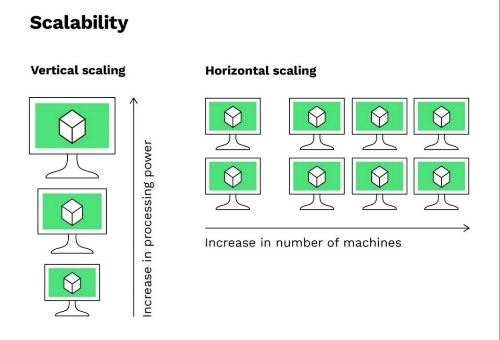
Vertical scaling means boosting a single machine’s power—adding more CPU, RAM, or storage. It’s like upgrading your laptop to handle heavier software, but there’s a limit to how much you can expand.
- Horizontal Scaling (Scaling Out)
Horizontal scaling involves adding more machines to distribute the workload. Think of it as hiring more employees instead of asking one to work overtime. This method is common in cloud computing.
- Load Balancing
Load balancing ensures even distribution of tasks across multiple servers in horizontal scaling. Without it, some servers might get overloaded while others sit idle.
- High Availability
High availability means keeping a system running with minimal downtime. Horizontal scaling improves this by spreading tasks across servers, reducing the risk of a single point of failure.
Questions People Also Asked
- What is better: vertical or horizontal scaling?
Neither is universally better—it depends on your needs. Vertical scaling is simpler but limited by hardware. Horizontal scaling offers flexibility but requires more management.
- When should I use vertical scaling?
Use vertical scaling for applications that aren’t designed for distributed systems. It’s ideal for small to medium workloads where upgrading hardware is cost-effective.
- Is horizontal scaling more expensive?
Initially, yes—because you need multiple machines. However, cloud services make it affordable long-term since you only pay for what you use.
- Can I combine both scaling methods?
Yes! Many systems use a hybrid approach, scaling vertically for immediate needs and horizontally for long-term growth.
- Does scaling affect database performance?
Absolutely. Vertical scaling may speed up a single database, while horizontal scaling requires partitioning data across servers, which can complicate queries.
Summary
Choosing between vertical and horizontal scaling depends on your project’s needs. Vertical scaling is simpler but has hardware limits, while horizontal scaling offers flexibility at the cost of complexity. Understanding both methods helps optimize performance, whether you’re managing a small app or a large-scale cloud system.
By evaluating factors like cost, performance, and future growth, you can make an informed decision that keeps your system running smoothly.
#TechScaling #WebDevelopment #CloudComputing #ITInfrastructure #DataManagement #DevOps #ServerManagement #HighAvailability #LoadBalancing #TechTrends