Why Your Website Traffic Dropped Even Though You’re Posting Regularly — And What to Do About It
You’re Publishing More Than Ever — So Why Is Your Website Traffic Going Backward?
You’re posting every week, doing everything right — yet your traffic keeps falling. Something’s broken, and it’s not your content.
You’re posting consistently, yet traffic keeps dropping. Discover 7 real reasons why — from AI overviews stealing clicks to content decay — and how to fix it fast.
Why Your Website Traffic Dropped Even Though You’re Posting Regularly
Introduction
Let me paint a picture that might feel familiar. You log into Google Analytics on a Tuesday morning, coffee in hand, ready to feel good about the work you’ve been putting in. You’ve been posting consistently — two, maybe three times a week. Your topics are solid. Your writing has improved. And yet, the numbers on the screen look like they belong to someone who gave up six months ago.
That right there? That is one of the most disorienting experiences in the digital world. And it happens to more creators, marketers, and business owners in the United States than you’d think. In fact, recent analysis across 50,000 B2B websites found that 73% experienced significant traffic loss between 2024 and 2025, with the average decline reaching 34% year-over-year. [KEO Marketing](https://keomarketing.com/seo-traffic-decline-2025/)
So no, you’re not imagining it. And no, you’re probably not doing something catastrophically wrong. The truth is more nuanced — and more fixable — than you think. Let’s walk through it together.
It’s Not Just You — The Rules Changed
Here’s the hard truth that nobody wants to say out loud: posting regularly was never the full answer. It was one piece of a much bigger puzzle. Search engines don’t hand out traffic like gold stars for effort. They reward relevance, authority, and technical performance. And those three things are always moving targets.
Something dramatic happened in early 2025. HubSpot — the company that literally wrote the playbook on content marketing — watched their organic traffic fall off a cliff. From a peak of 24 million monthly visitors in 2022, they dropped sharply, and the real crash came in early 2025, sending shockwaves through the content marketing world. This wasn’t supposed to happen. HubSpot has one of the strongest SEO teams in the industry. [Alitu](https://alitu.com/creator/content-creation/is-seo-dead-in-2025/)
If it happened to them, it can happen to anyone. So let’s break down exactly why your traffic dropped — and what you can actually do about it.
Your Analytics Might Be Lying to You
Before you panic and rewrite your entire content strategy, check something simple first. Is your tracking actually working?
Analytics tools like Google Analytics can silently break during routine site updates, theme changes, or plugin installations. A removed script tag, a misfire on your consent banner, or a bot filter that’s now excluding real users — any of these can make your traffic look like it dropped when it actually didn’t.
Here’s the quick test: open Google Search Console and look at your impressions. If your impressions are holding steady while your reported sessions are falling, your tracking tag is likely the culprit, not your content. Fix the tag first. Use Google Tag Assistant to verify it’s firing correctly. It’s a boring fix, but it saves a lot of unnecessary headaches.
Google’s Algorithm Keeps Moving the Goalpost
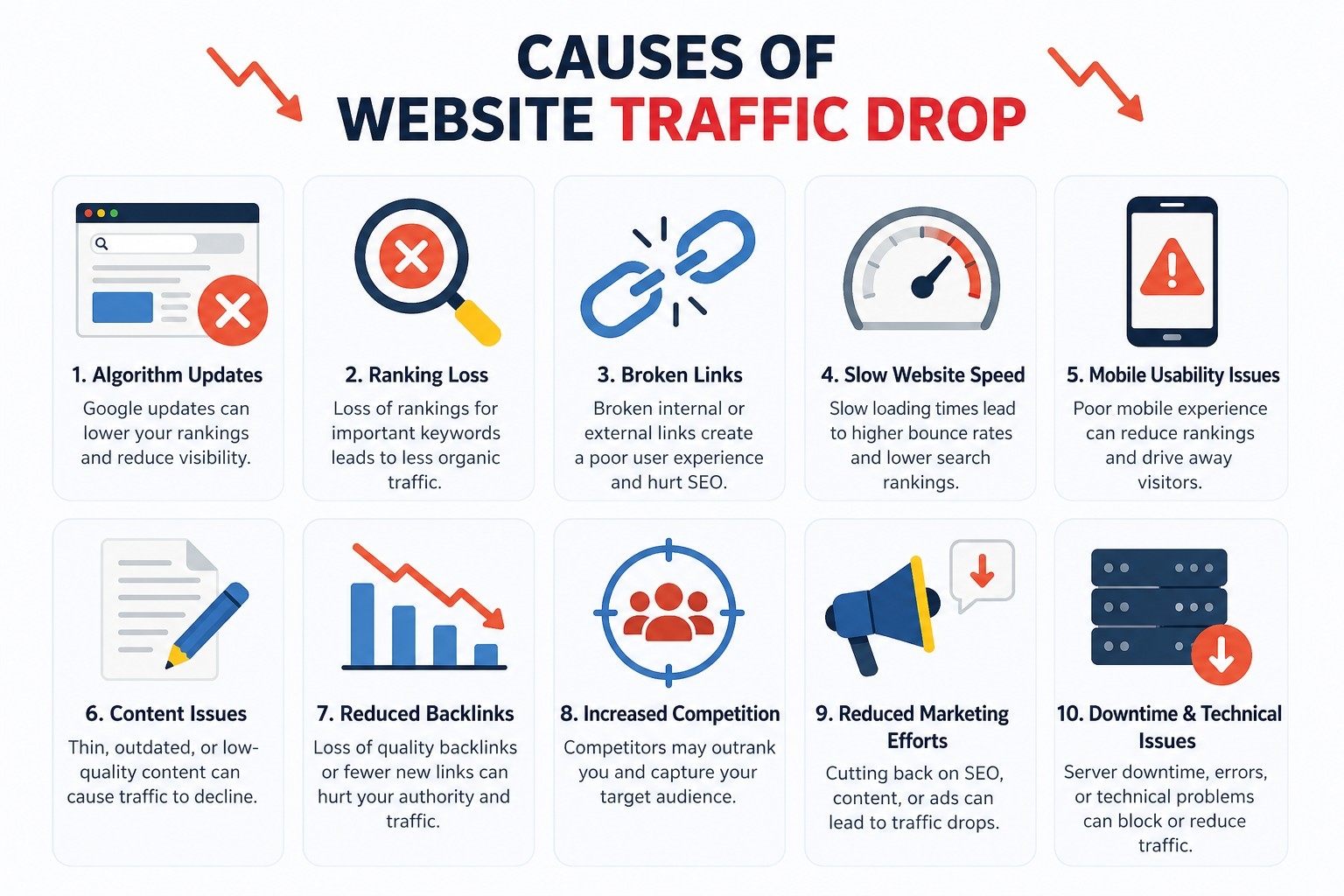
Even if your tracking is perfect, a Google core update may have knocked your pages down a few positions. And a few positions is all it takes.
Google rolls out multiple core updates every year. The December 2025 core update, which began rolling out on December 11, focused on improving search quality — rewarding helpful, reliable content and tightening spam policies against copied content and misinformation. [Viacon](https://viacon.io/blog/google-core-update-traffic-loss/)
These updates emphasize something called E-E-A-T — Experience, Expertise, Authoritativeness, and Trustworthiness. If your content doesn’t clearly demonstrate those four things, even a well-written, consistently published article can quietly lose ground.
The solution isn’t to post more. It’s to post with more substance. Add author bios. Cite real data. Link to credible sources. Show your readers — and Google — that a human with genuine experience wrote what they’re reading.
Your Old Content Is Rotting
This one stings a little, but it’s important. Content has a shelf life. Something you published 18 months ago might have been brilliant then. But if the statistics are outdated, the examples are old, or competitors have published something deeper, your article is slowly losing its grip on rankings.
The pattern shows up in your analytics as a slow bleed. You’re not losing all your traffic at once. You’re losing 5% here, 8% there. Losing just two or three ranking positions across 100 pages can eliminate 30 to 40 percent of your organic traffic — even though no single page crashed. [Wellows](https://wellows.com/blog/why-your-website-traffic-is-dropping/)
The fix is content auditing. Set aside time every quarter to review your top-performing posts. Update the stats. Replace outdated examples. Add a FAQ section or a tool if users are now expecting that. You’ll often recover rankings faster by refreshing one strong piece than by publishing five brand-new ones.
Technical Problems No One Told You About
Here’s something that surprises a lot of people: you can write excellent content and still lose traffic because of issues that have nothing to do with your writing. Slow load times. Mobile usability errors. Broken links that waste your crawl budget. A line in your robots.txt file that accidentally tells Google not to index key pages.
These are technical SEO issues, and they’re more common than most site owners realize. Run your site through Google’s PageSpeed Insights. Check the Coverage report in Search Console for crawl errors. Make sure your images are compressed and your site loads in under three seconds on mobile.
None of this is glamorous work. But it’s the kind of thing that, when fixed, quietly restores the foundation your content is trying to stand on.
AI Ate Your Clicks — And Your Traffic Never Came Back
This is the big one. The shift that’s affecting everyone right now, from solo bloggers to enterprise content teams.
AI Overviews now appear in nearly 16% of Google queries as of late 2025. When AI Overviews show up, organic click-through rates dropped 61% — from 1.76% down to 0.61% — on those same queries. [Wellows](https://wellows.com/blog/why-your-website-traffic-is-dropping/) Your rankings might not have moved at all. But the users are getting their answers directly from Google’s AI summary box and never making it to your site.
Since Google rolled out AI Overviews, websites have seen an increase in impressions while clicks through to the actual website have dropped — a growing pattern of “zero-click searches” where users find exactly what they need without ever leaving Google. [Mktgessentials](https://mktgessentials.com/blog/why-your-website-traffic-is-declining-in-2025-the-great-decoupling)
So what do you do? You optimize to be cited inside those AI Overviews, not just ranked below them. That means using structured data and schema markup, writing clear and direct answers to specific questions, and building the kind of E-E-A-T signals — like author credentials and cited sources — that AI systems trust enough to reference. The goal shifts from “rank on page one” to “be the source AI pulls from.”
You’re Accidentally Competing With Yourself
This one is easy to miss. If you’ve been publishing consistently for a while, there’s a good chance some of your newer posts are targeting the same keywords as older ones. Search engines get confused when multiple pages on your site are competing for the same term. Instead of picking a winner, they often split the ranking authority — and both pages end up performing below what either could have achieved alone. This is called keyword cannibalization.
Use a tool like Ahrefs or Semrush to map out which keywords each page is targeting. If you spot duplicates, consolidate them. Either merge the pages into one stronger piece or use a 301 redirect to point the weaker page toward the stronger one. One authoritative page will always outrank two mediocre ones.
Your Competitors Didn’t Stand Still
While you were posting consistently, your competitors were busy too. They were refreshing their content, earning better backlinks, and adapting faster to what users actually want — which sometimes means interactive tools, video content, or original data instead of just a well-written article.
Artificial intelligence has dramatically reduced the opportunity cost of content creation, which means more content is being produced than ever before — and more content means more competition for the same keywords. [Wecreate](https://www.wecreate.com/insights/traffic-dropped-2025-fix-it)
The way to outcompete isn’t to out-publish them. It’s to out-differentiate. Conduct original research. Create a free tool or calculator your audience actually needs. Write with a perspective that’s genuinely yours. Those are things competitors can’t copy overnight.
How to Recover — And Stay Recovered
Here’s a simple sequence to follow. Start by validating what’s actually happening — use Google Search Console and GA4 together to separate a real traffic drop from a tracking error. Then fix your technical foundation. Then audit and refresh your best-performing content. Finally, build authority through backlinks, author credibility, and structured data.
Some marketers are reporting traffic drops of 40% or more — but businesses focused on bottom-of-funnel content, where users are actively looking for a product or service, tend to see much smaller declines. [Grow and Convert](https://www.growandconvert.com/ai/seo-traffic-decline-chatgpt-ai/) Intent matters more than volume. Targeting the right audience — even a smaller one — will always outperform chasing broad, generic traffic that never converts.
Expect some stabilization in two to eight weeks once fixes are in place. Full recovery typically takes three to six months of consistent effort. Track impressions and click-through rate first — those will move before your overall traffic numbers do.
Consistent publishing is still valuable. But it’s a habit, not a strategy. The strategy is everything that makes each piece worth reading, worth ranking, and worth clicking on.
Important Phrases Explained
Organic CTR (Click-Through Rate): Organic CTR refers to the percentage of people who see your website in search results and actually click through to it. It’s one of the most telling metrics in SEO because it tells you whether your titles, meta descriptions, and content are compelling enough to earn a click. A drop in organic CTR — without a drop in impressions — often signals that something is intercepting your traffic before users reach you, such as AI Overviews, featured snippets, or poorly optimized meta tags. Monitoring CTR in Google Search Console helps you identify which pages are losing clicks even when they’re still showing up in search.
Content Decay: Content decay describes the natural, gradual decline in traffic and rankings that happens to web pages over time as search intent shifts, competitors publish stronger resources, and the information within a piece becomes outdated. It’s one of the quietest killers of organic traffic because the decline is slow and rarely triggers an alarm. A post that drove consistent traffic 18 months ago may now rank several positions lower simply because newer, more comprehensive content has replaced it in Google’s eyes. Regular content audits — updating statistics, adding new examples, and improving page depth — are the most reliable antidote.
E-E-A-T (Experience, Expertise, Authoritativeness, Trustworthiness): E-E-A-T is Google’s framework for evaluating the quality and credibility of web content. It stands for Experience, Expertise, Authoritativeness, and Trustworthiness. After several major algorithm updates, Google has made it increasingly clear that it rewards content backed by real human knowledge and lived experience — not just content that ticks SEO boxes. For website owners, this means including author bios with credentials, citing reputable sources, and demonstrating first-hand knowledge of the topic at hand. Thin, generic content increasingly struggles to compete in a landscape where E-E-A-T signals carry real weight.
Zero-Click Searches: A zero-click search happens when a user types a query into Google and gets their answer directly on the search results page — through an AI Overview, a featured snippet, a Knowledge Panel, or another SERP feature — without ever clicking through to a website. This trend has accelerated sharply with the rollout of AI Overviews. In 2025, an estimated 60% of searches ended without a click. For content creators, this means visibility and traffic are increasingly decoupled. You can rank well and still receive little to no traffic if your content type tends to trigger these no-click result formats.
Keyword Cannibalization: Keyword cannibalization occurs when multiple pages on the same website target the same or very similar keywords, causing them to compete against each other in search rankings. Instead of one strong page dominating the results, search engines become unsure which page to prioritize — so both pages underperform. This is a surprisingly common issue on blogs that have been publishing consistently over a long period. The fix involves conducting a keyword mapping audit, consolidating overlapping pages, and using 301 redirects to channel authority toward the strongest version of a given piece of content.
Questions Also Asked by Other People — Answered
Why did my website traffic drop overnight? A sudden overnight traffic drop usually points to one of three things: a Google algorithm update that reshaped rankings across your niche, a technical issue such as a broken tracking tag or an accidental robots.txt block that prevents search engines from crawling your pages, or a manual penalty from Google for policy violations. The fastest way to diagnose it is to open Google Search Console and check the Coverage and Performance reports side by side. If your impressions also fell sharply, rankings were affected. If only clicks fell while impressions held steady, your content is still visible — but something is intercepting users before they reach your site.
Does posting more content increase website traffic? Posting more content can support traffic growth, but volume alone is not a reliable traffic strategy. What matters more is whether each piece of content targets a specific, answerable search intent, demonstrates genuine expertise, and is technically optimized for search engines to find and index. Publishing five in-depth, well-researched articles will consistently outperform publishing twenty thin, repetitive ones. In fact, excessive publishing with minimal differentiation can dilute your site’s overall quality signals, which may harm your existing rankings rather than improve them.
How long does it take to recover from a Google algorithm update? Recovery timelines after a Google algorithm update vary depending on the scale of the impact and how quickly you identify and address the underlying issues. In many cases, sites that make targeted fixes — improving content quality, correcting technical errors, and building credibility signals — begin to see stabilization within two to eight weeks. Full recovery, however, often takes three to six months of consistent effort. It’s also worth noting that Google occasionally releases “reversal” updates or follow-up refreshes that can naturally restore some rankings, so patience and ongoing monitoring are both essential during the recovery period.
What is causing my organic traffic to drop even though my rankings haven’t changed? This is one of the most frustrating and increasingly common situations in SEO today. The likely cause is AI Overviews or other zero-click SERP features that are appearing above the organic results and answering users’ questions directly on the search page. Your ranking position may be intact, but fewer users are reaching the point where they need to click. The best response is to optimize your content to appear within AI-generated summaries by using structured data markup, providing concise and authoritative answers, and reinforcing your E-E-A-T signals so that AI systems are more likely to cite your content as a source.
How do I know if my content is suffering from content decay? Content decay is typically visible in your Google Analytics or GA4 data as a slow, sustained decline in traffic to previously strong pages — not a sudden crash but a gradual erosion over weeks or months. You can identify decaying content by sorting your pages by year-over-year traffic change and looking for pages that have consistently declined despite no major changes. Additional signals include falling click-through rates in Google Search Console, slipping rankings for core keywords, and pages that once ranked in the top five now appearing on page two or three. The fix is a structured content refresh — updating statistics, deepening the coverage, and aligning the page more closely with current search intent.
Summary
If your website traffic has dropped despite consistent publishing, the cause is almost certainly one of several interconnected issues — not a single dramatic failure. Google’s algorithm updates continue to reward experience, authority, and depth over sheer publishing volume. AI Overviews are intercepting a growing share of clicks before users ever reach your site. Older content is gradually losing relevance as competitors publish stronger resources and as search intent evolves. Technical problems like slow load times, crawl errors, and broken tracking tags compound the damage silently in the background. Keyword cannibalization dilutes the authority of multiple pages that should be working together.
The good news is that every one of these issues is diagnosable and fixable. Start with your data — Google Search Console and GA4 together will tell you most of what you need to know. Then fix your technical foundation, refresh your best-performing content, and build the credibility signals that both search engines and AI systems increasingly rely on. Posting consistently still matters. But consistency with strategy is what actually moves the needle. Recovery takes time — typically three to six months — but with the right approach, it’s absolutely achievable.
#WebsiteTraffic
#SEOTips
#ContentMarketing
#GoogleAlgorithm
#DigitalMarketing