Advanced Schema Markup in 2026: What Actually Still Works (And What Doesn’t)
I Spent a Weekend Rebuilding My Site’s Schema. Here’s the Mistake Almost Everyone Is Still Making in 2026.
Google just killed one of the most popular types of schema markup. Most sites haven’t noticed yet.
Google quietly changed the rules on schema markup in 2026. Here’s what still earns rich results, what got cut, and exactly how to fix your site without guessing.
Introduction
A few months ago I pulled up Search Console and noticed something odd. A client’s FAQ rich results, the little dropdown questions that used to sit right under their blog posts, were just gone. Not flagged. Not broken. Gone, like they’d never existed. I figured it was a glitch. It wasn’t.
Turns out Google quietly retired FAQ rich results for most websites back in May 2026. If you’ve been leaning on FAQ schema as your go to move for grabbing extra real estate in the search results, that strategy stopped working months ago and you might not even know it yet.
So let’s talk about what advanced schema markup actually looks like in 2026, what’s worth your time, and what’s just dead weight sitting in your code.
What schema markup actually does
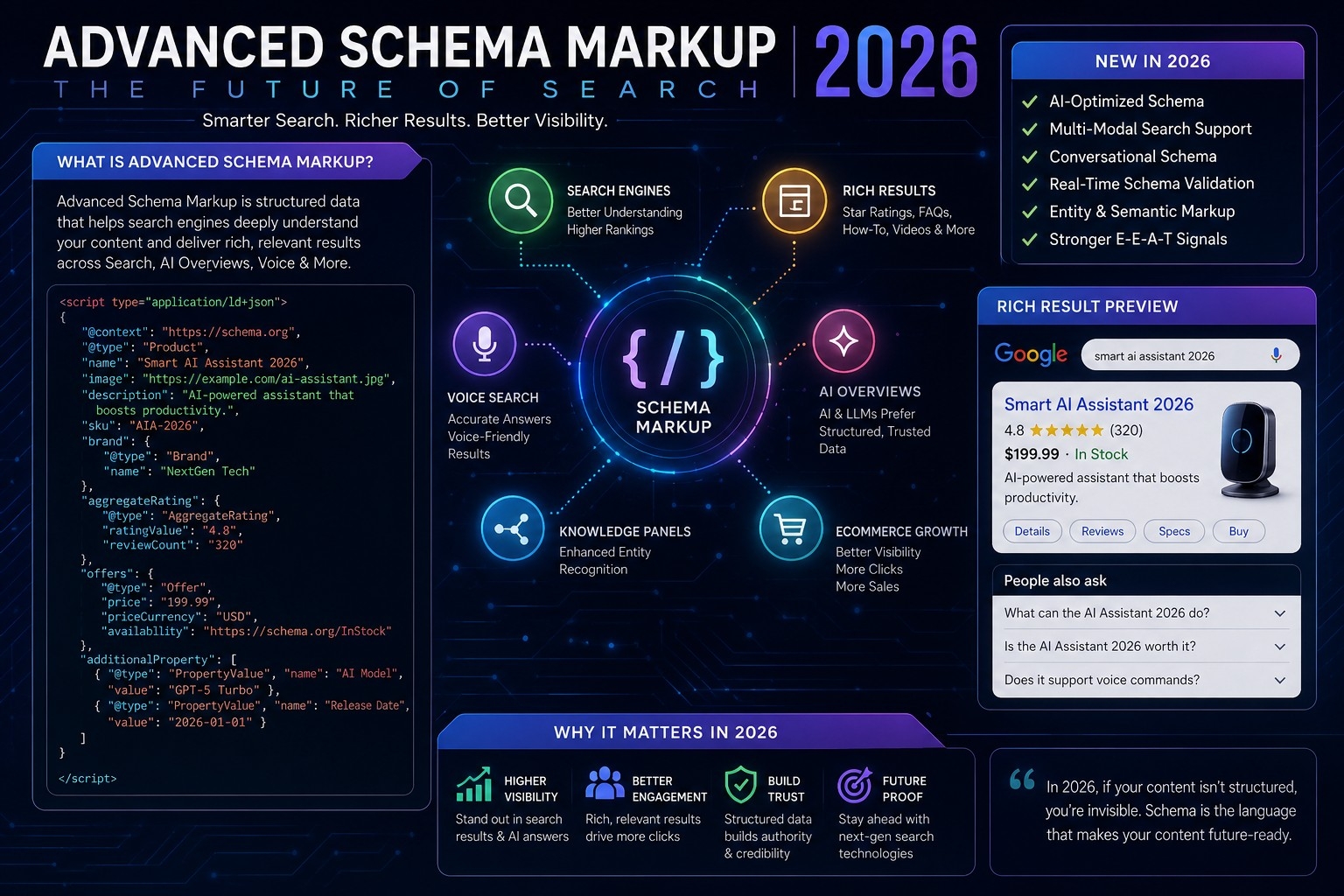
Here’s the simplest way I can put it. Normal HTML tells a browser how to display something. Schema markup tells a search engine, and increasingly an AI system, what that something actually means.
Say you’ve got a paragraph of text on your site. Regular HTML says “this is a paragraph.” Schema markup says “this paragraph is the author bio,” or “this number is a price,” or “this date is when the event starts.” That distinction matters more than it sounds like it should, because machines are terrible at guessing. Schema takes the guesswork out of it.
Most of this gets written in a format called JSON-LD. It sits in a script tag, usually in the page’s head section, completely separate from the content someone actually sees on the page. Your CMS or database can generate it automatically, which is honestly the whole point. Nobody wants to hand write structured data for every single page.
Why 2026 is a different game
I want to be straight with you here, because a lot of what’s floating around online is outdated. Between June 2025 and May 2026, Google pulled support for eight different rich result types. Book Actions, Course Info, Claim Review, Estimated Salary, Learning Video, Special Announcement, and Vehicle Listing were retired first. Then, in May 2026, FAQ rich results followed for the vast majority of sites, with a narrow exception carved out for government and health related domains.
None of this hurt anyone’s rankings directly. Google was clear about that. What it did was strip away the visual perks, the dropdown boxes, the extra clicks, the stuff that made your listing stand out from the plain blue links around it. If your SEO strategy was built around stacking FAQ schema onto every page hoping for a shortcut, that shortcut closed.
What actually still works
The good news is the core schema types are more important now, not less. Article and BlogPosting schema has become the backbone for content sites. It signals authorship, publish dates, and freshness, and those signals now do double duty. They help you show up as a rich result and they help Google’s AI systems decide whether to cite your page when someone asks a question in AI Overviews or a similar interface.
Product schema is thriving too, especially as Google leans harder into AI powered shopping experiences. If you run an online store and your product pages have honest, up to date pricing and availability data, that markup is doing real work for you.
Review schema, when it reflects genuine customer feedback, still pulls those star ratings into search results. Organization schema still anchors your brand identity, your logo, your official name, and your connections across the web through sameAs links to places like your LinkedIn or Crunchbase profile. BreadcrumbList schema is still one of the easiest wins on the list, since it just cleans up how your page’s location in the site shows up in search.
Video schema, event schema, local business schema, job posting schema, these are all still active and useful, provided they genuinely match what’s on the page.
FAQ schema isn’t dead exactly. It just isn’t doing what it used to. Unless you run a government or healthcare site, don’t expect the visual dropdown anymore. You can still use it for your own internal structure or accessibility purposes, but stop treating it like a search visibility tactic.
Building an entity profile, not a pile of tags
The mindset shift I’d encourage for 2026 is this. Stop thinking about schema as a checklist of tags to sprinkle on pages. Start thinking about it as building a trustworthy, connected profile of your business that a machine can verify.
That means your business name, address, and logo should be identical everywhere they appear online, not “Smith Consulting LLC” on one page and “Smith Consulting” on another. It means your blog posts should consistently name the author and link that author back to a real profile. It means your service pages, your location pages, and your product pages should all reinforce each other rather than existing in isolation.
Think of it like a resume. One inconsistency, a wrong date, a missing job, and the whole thing looks less credible. Schema works the same way. Search engines and AI systems are now cross checking your markup against your visible content and against other trusted sources. Consistency is the whole game.
A workflow that actually holds up
If you’re setting this up for the first time, or fixing an outdated setup, here’s the order that works.
First, figure out which schema type genuinely matches the page. Don’t force FAQPage onto a page that has no actual questions and answers.
Second, generate the JSON-LD from your real page data, not hardcoded values that’ll go stale the moment something changes.
Third, drop it into your template or CMS layer so it updates automatically going forward.
Fourth, test the live page with Google’s Rich Results Test to check eligibility, and run it through the Schema Markup Validator for broader syntax checking. These two tools do different jobs, so use both.
Fifth, keep an eye on the Enhancements section of Search Console. It’ll flag warnings and errors before they become a real problem.
Sixth, and this is the one people skip, update the schema whenever the page content changes. A product marked “in stock” that’s actually sold out isn’t just unhelpful, it can get your markup ignored or treated as spam.
The mistakes that keep showing up
I still see the same handful of mistakes on client sites, over and over. Marking up content that isn’t actually visible on the page. Using the wrong schema type because it seemed close enough. Faking ratings or pricing to make a listing look better than it is. Letting outdated values sit in the markup for months. Stacking multiple conflicting structured data blocks on a single page because two different plugins both decided to add their own.
Search engines have gotten stricter about all of this, not looser. If your schema says one thing and your visible page says another, the safest assumption is that your markup gets discounted or ignored entirely.
Where the real value comes from
Schema markup won’t rescue a weak page. It doesn’t create authority out of nothing, and it isn’t a ranking factor in the way backlinks or genuinely useful content are. What it does is make an already good page easier to understand, easier to trust, and more likely to earn the extra visual space in search results that pulls in clicks.
I think of it as translation work. Your content already says what it needs to say to a human reader. Schema just makes sure the machines reading it get the same message, clearly, without having to guess.
If you only do a few things this year, get your Organization schema locked in, make sure every blog post has proper Article schema with a real author, add BreadcrumbList across your site, and if you sell anything, get your Product schema accurate and current. That’s not flashy advice, but it’s the stuff that’s still working in 2026, long after the shinier tactics got quietly turned off.
Important Phrases Explained
Schema markup 2026. People searching this phrase usually want to know if the old advice still applies. It mostly does, with the notable exception of FAQ rich results, which changed significantly this year. Anyone researching this term should specifically check what Google currently supports rather than relying on guides written before mid 2026.
JSON-LD structured data. This is the technical format almost every modern schema implementation uses. Searchers looking this up are usually developers or site owners trying to understand how to actually add the code to their site, typically through a script tag or a CMS plugin, rather than editing raw HTML by hand.
Rich results eligibility. This phrase points to a common misunderstanding. Adding correct schema doesn’t guarantee a rich result will appear. Google decides eligibility based on content quality, schema type restrictions, and now increasingly on trust and E-E-A-T signals, so this search usually comes from someone whose schema validates fine but still isn’t showing up in results.
FAQ schema removed. This is a newer, high intent search that spiked after May 2026. Site owners noticed their FAQ dropdowns disappeared and went looking for an explanation. The short answer is that Google discontinued FAQ rich results for most sites, keeping them only for government and health domains.
Schema markup for AI search. This reflects a real shift in why people care about structured data now. It’s not just about search snippets anymore. AI systems use structured data to verify facts and decide what to cite, so accurate, consistent schema increasingly affects whether your content gets referenced in AI generated answers.
Questions Also Asked by Other People Answered
Does schema markup improve rankings directly? Not directly, no. Google has said repeatedly that structured data isn’t a ranking factor on its own. What it does is improve how your page can be displayed and understood, which can lead to better click through rates and, indirectly, stronger overall performance.
Is FAQ schema still worth adding to my site? For most businesses, not for the visual rich result anymore, since that stopped appearing for non government, non health sites in May 2026. It can still help organize content for accessibility or internal search, but don’t expect the search results dropdown.
What’s the best way to add schema to a WordPress site? Plugins can handle the basics well, especially for Article, Organization, and BreadcrumbList schema. For larger or more complex sites, dynamically generating JSON-LD from your actual database fields tends to hold up better over time, since it updates automatically instead of going stale.
How do I know if my schema is actually working? Run the page through Google’s Rich Results Test to check eligibility for specific features, and check the Enhancements reports inside Search Console regularly. Those reports will flag both errors and pages that are valid but not generating the enhancement you expected.
Can I use fake reviews or prices in my schema to look more attractive in search? No, and it’s genuinely risky to try. Search engines cross check your markup against your visible page content and other signals. Inaccurate or fabricated data in your schema can get your structured data ignored entirely, or in more serious cases, flagged as manipulative.
Summary
Google made significant changes to structured data support throughout 2025 and into 2026, most notably removing FAQ rich results for the majority of websites in May 2026. This doesn’t mean schema markup lost its value. It means the strategy shifted. Article, Product, Review, Organization, and BreadcrumbList schema remain strong performers, and structured data now plays an added role in helping AI systems verify and cite content accurately. The most effective approach in 2026 isn’t stacking as many schema types as possible onto a page. It’s building a consistent, accurate entity profile across your site, keeping your data synchronized with real business information, and matching schema types to genuine page content. Schema markup still won’t fix a weak page, but on a strong one, it makes the difference between being understood by search engines and being guessed at.
#SchemaMarkup #TechnicalSEO #WebDevelopment #SEO2026 #StructuredData